
Fuel prices in Guatemala have risen steadily since February 2026, when the conflict between the United States and Iran began. The government authorized a Q2 billion (USD $262 million) subsidy in April, but the funds ran out at the end of July and prices rebounded.
The increase led to protests and roadblocks by truckers, as well as warnings of possible increases in intercity transportation fares.
From July to the end of September, prices have increased as follows[1]:
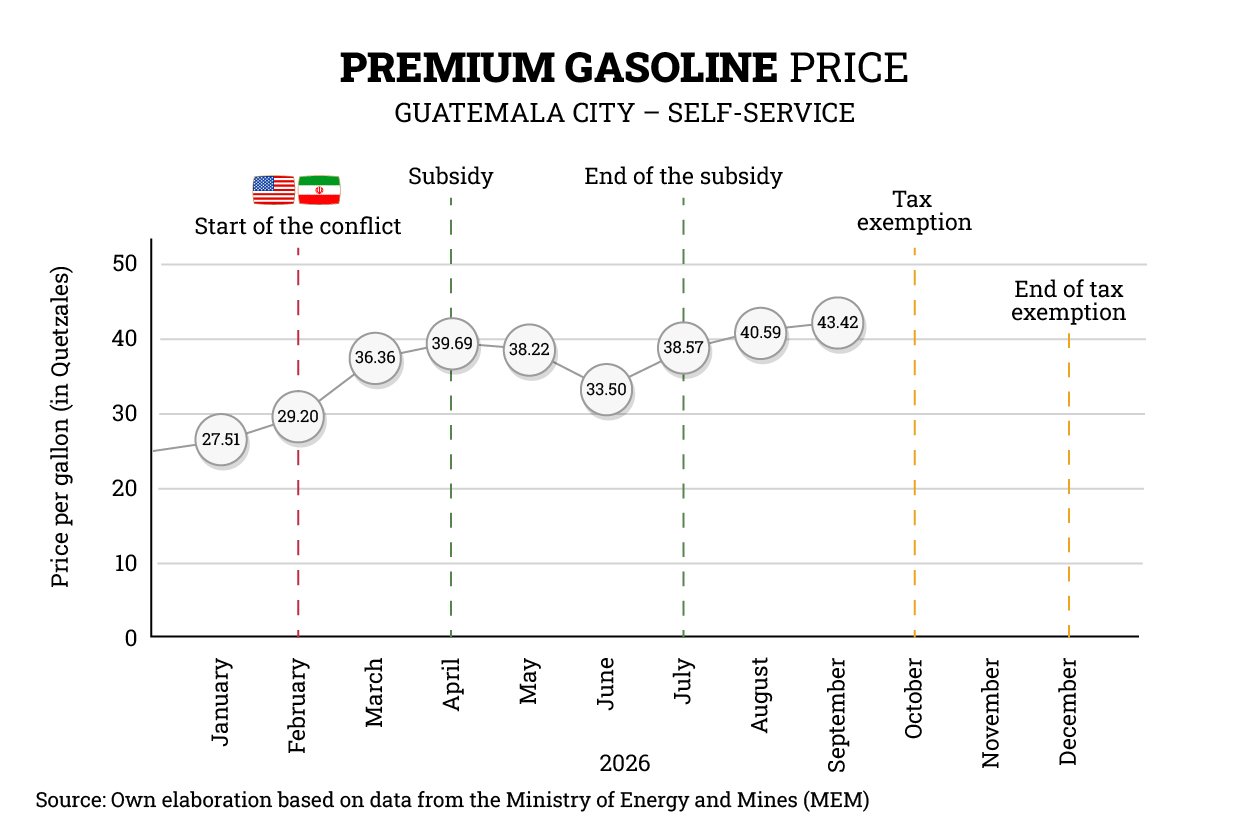
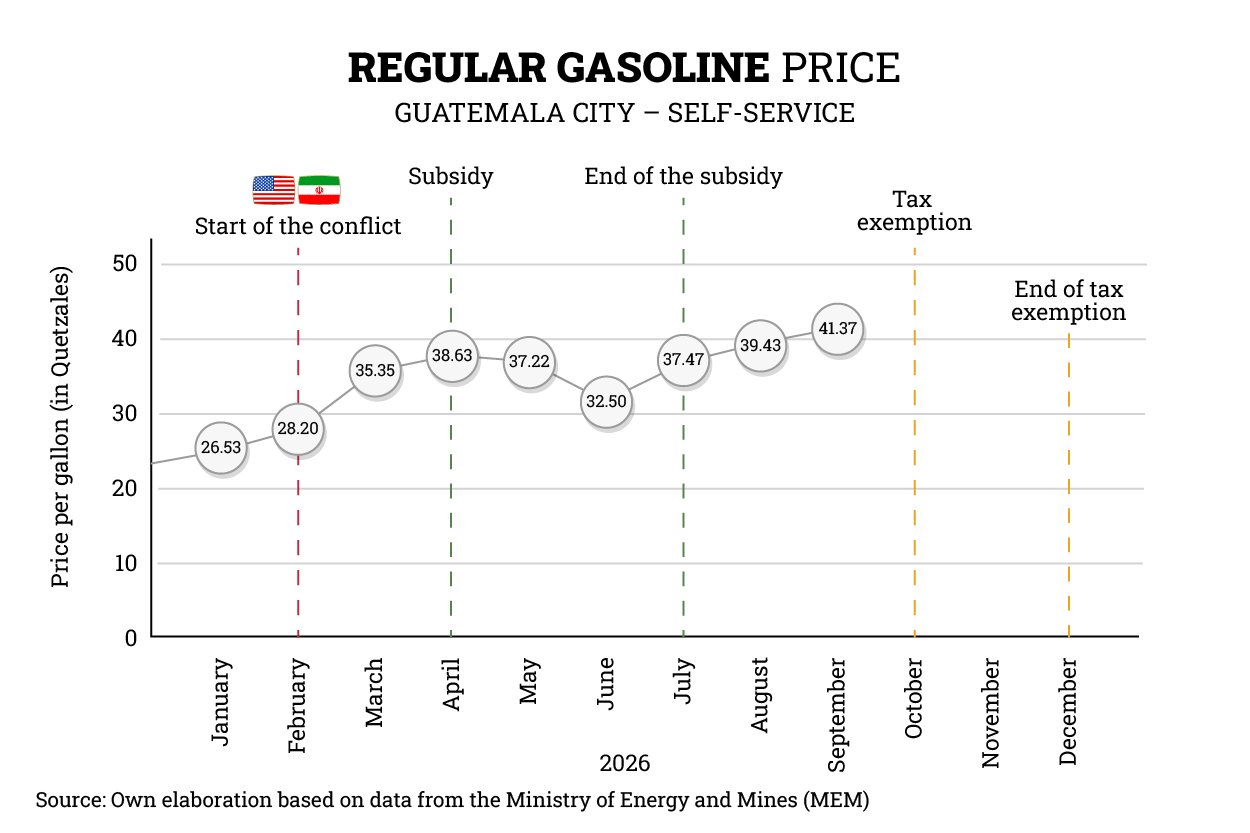
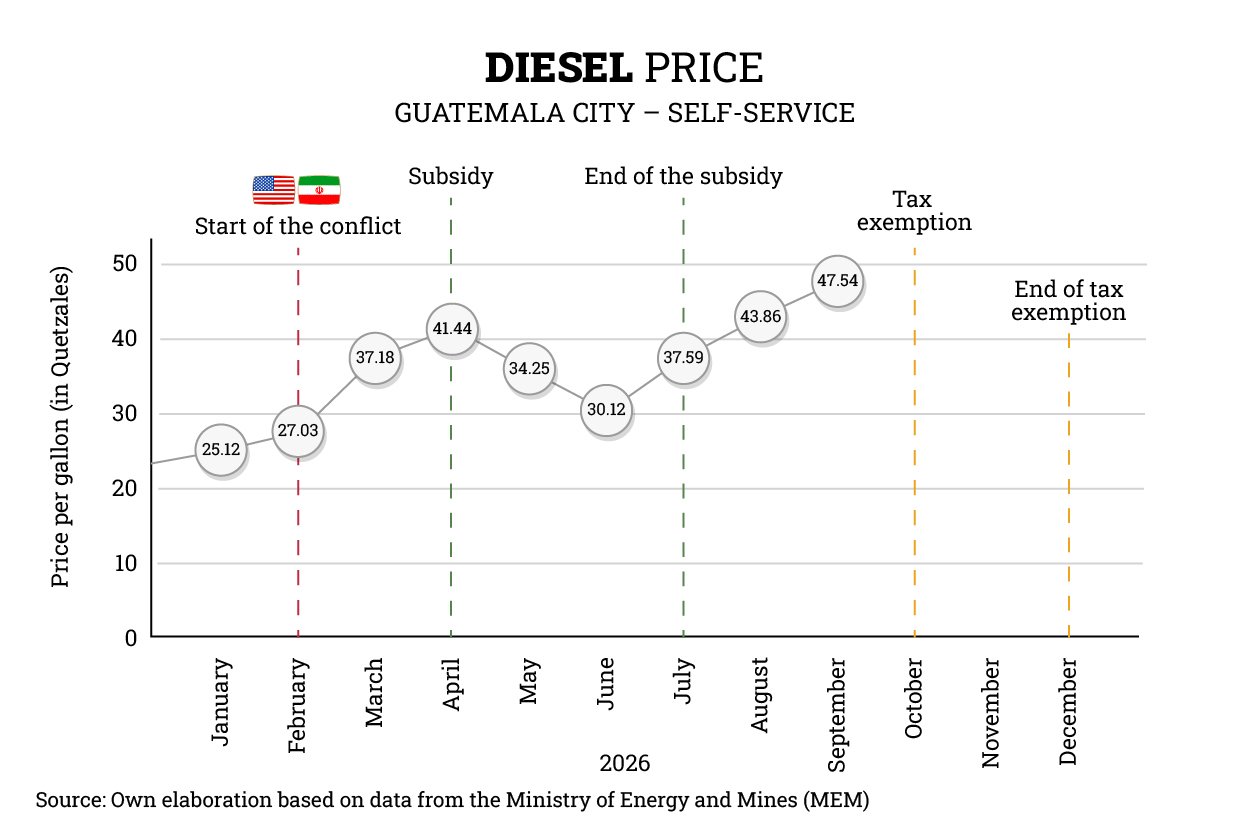
President Bernardo Arévalo signed Decree 22-2026[2], the Emergency Temporary Tax Exemption Act for Fuel Consumers, which was published on Wednesday, September 30, in the official gazette. The exemption took effect on October 1 and will expire on December 31, 2026.
On Tuesday, September 22, Congress approved the Decree as a matter of national urgency in a single debate. The initiative received the support of 148 congressmembers, with no votes against it. It was jointly sponsored by representatives from various congressional caucuses, including both the ruling party and the opposition.
The Executive ruled out the option of price caps: through Government Agreement 159-2026, the President vetoed Decree 21-2026, the Law on Stabilization and Reference Prices for Final Consumer Sales of Covered Fuels, which established maximum prices of Q39 (USD $5.1) per gallon for diesel and regular gasoline and Q41 (USD $5.36) for premium gasoline. That decree was returned to Congress with the objections raised.
Meanwhile, Decree 22-2026 suspends the collection of the Value-Added Tax (VAT) and the Tax on the Distribution of Crude Oil and Petroleum-Derived Fuels (IDP). As reported, the VAT exemption will apply temporarily to regular gasoline, premium gasoline, diesel, gas oil, and fuel alcohol.
Effective January 1, 2027, fuels will once again be subject to taxation at their standard rates, without the need for any additional provision.
The calculations included in the decree estimate a reduction of up to Q9.41 (USD $1.23) per gallon for premium gasoline, consisting of Q4.71 (USD $0.62) in VAT and Q4.70 (USD $0.61) in IDP. For regular gasoline, the estimated reduction is Q9.10 (USD $1.19), while for diesel it amounts to Q6.34 (USD $0.83), of which Q5.04 (USD $0.66) corresponds to VAT and Q1.30 (USD $0.17) to the IDP.
Based on the average prices reported by the Ministry of Energy and Mines (MEM) as of September 28, the tax reduction would bring premium gasoline to approximately Q35.88 (USD $4.69) per gallon, regular gasoline to Q34.16 (USD $4.46), and diesel to Q43.03 (USD $5.62), assuming all other price components remain. It is important to note that these figures do not constitute maximum prices or prices set by the government; the law does not establish a maximum retail price, so any variation in international costs may be reflected in the final price.
Gas stations must translate the full discount to consumers and itemize it on the electronic receipt. The MEM will oversee the implementation of the exemption, and retailers must report their retail prices daily. The Direction of Consumer Services and Assistance (Diaco) will impose penalties on those who fail to apply the price reduction, and the Superintendency of Tax Administration (SAT) and the MEM will monitor compliance.
The SAT will have five business days to make the necessary adjustments to the online electronic invoicing system and to the records of the National Customs System. The MEM must issue the implementing regulations within the same timeframe; however, Article 12 of the decree stipulates that, if these regulations are not issued within the established time frame, the application of the exemptions and the mandatory passing on of the reduction to the final price will not be suspended.
Additionally, taxes paid before the law took effect will not be refunded, and it is prohibited to export fuel that has benefited from the exemption.


Published on October 2, 2026.