

#FreshStartMonday
Welcome to #FreshStartMonday!
“Trust me, I get it – there is so much to absorb in the crypto space, but I’m here to help you along the way.” ― Najah Roberts
Cryptocurrencies are part of a digital payment system that does not rely on banks to verify the transactions made, being decentralized. It is known to be a peer-to-peer system,peer-to-peerwhich allows anyone anywhere in the world to send and receive payments immediately.
Cryptocurrencies are stored in digital wallets. The storage and transmission of cryptocurrency data between digital wallets and public ledgers requires advanced encryption (cryptography). The purpose of encryption is to provide security and protection to its users.
Cryptocurrencies operate through a distributed public ledger or ledger called blockchainwhich, is a record of all transactions made. These are created mainly through a process called mining, which consists of using the power of different computers to solve high-level mathematical problems and, therefore, generate coins. Likewise, users who do not wish to carry out mining, can buy cryptocurrencies from brokers to store, save or spend them through their digital wallet. A main characteristic is the intangibility of the coins, which makes their transaction very easy but makes them difficult to trace.
The main cryptocurrencies are:
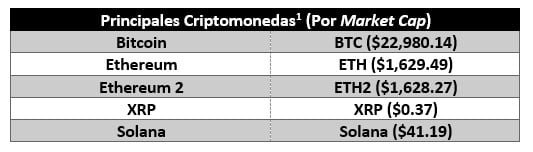
An important factor is to understand that cryptocurrencies do not have a fixed value, being highly volatile. The main factor in determining the value of a cryptocurrency is supply and demand. When a small volume of cryptocurrencies is generated with a lot of demand, the value of these will be high and vice versa. However, other factors such as user perception or sentiment around these digital assets and speculation, which consists of buying cryptocurrencies on an exchange and then reselling them on another at a higher price, also play a role. Clearly it can be concluded that regarding the value of cryptocurrencies, it is the user who is responsible for managing the market.
Current Regulation of Cryptocurrencies in Guatemala
In Guatemala, there is no current and specific regulation that defines, allows, prohibits, sanctions, or promotes the use of cryptocurrencies. Decree 17-2002, Ley Monetaria (Monetary Law), in its first article establishes that "The monetary unit of Guatemala is called Quetzal. The monetary symbol of the Quetzal is represented by the letter "Q"."
Since the Bank of Guatemala is the only entity that may issue bills and coins within the territory of the Republic of Guatemala the following aspects about virtual currencies (cryptocurrencies) should be considered:
- They are not legal tender by the State of Guatemala.
- They are not backed by the State of Guatemala.
- They are not considered currencies.
- They are not guaranteed, nor can they be forced to be accepted as a means of payment in transactions of goods and services.
- Their regulation and supervision are outside the Guatemalan national legal system.
As for their oversight, Guatemala does not currently have specific regulations governing cryptocurrencies, so there is no consensus as to their legal nature and potential tax burdens are a matter of concern for users. In general terms, transactions involving the exchange of goods and services imply Value Added Tax (Impuesto al Valor Agregado (IVA), Income Tax (Impuesto Sobre la Renta (ISR) and capital gains obligations. However, the tax interpretation of these currencies may vary according to the legal status given to them.
That is why we recommend that prior to investing in these, as well as other assets, the following steps be taken:
- Research about the markets and exchange sites.
- Learn about the storage of cryptocurrencies, their security, and conditions.
- Consider maintaining a diversified portfolio of cryptocurrencies according to your risk tolerance.
- Monitor and consider the volatility of the currency to be purchased.
For more information on digital currencies, blockchain and Fintech you can consult the following links: