
Guatemala began 2026 with its characteristic macroeconomic stability and a clear objective: to secure an investment-grade rating for the first time from Moody’s, Standard & Poor’s (S&P), and Fitch Ratings, the international credit rating agencies that evaluate the country.
This would allow the country to secure financing at lower interest rates and under better terms, gain credibility and trust on the international stage, and become more attractive to foreign investment. It is important to note that there are global funds that are only permitted to invest in countries with investment-grade ratings.
According to Fitch Ratings, a credit rating is “an opinion on a country’s relative ability to meet its financial obligations.” In other words, it reflects a country’s ability to service its debt and, consequently, the risk involved in investing in its economy.
That ability goes far beyond macroeconomic indicators. It is true that factors related to economic growth, the fiscal situation, inflation, and foreign exchange reserves are evaluated. But governance, political stability, the state of infrastructure, and structural problems such as poverty and inequality also carry weight in the rating.
In fact, rating agencies often point out that a fractured Congress hinders key reforms or that the Executive branch’s anti-corruption agenda faces serious threats. Some specific examples of situations that could positively or negatively impact the Guatemalan rating are:
- The election of new justices to the Supreme Electoral Tribunal (TSE), Constitutional Court (CC), and the new Attorney General, which will all take place in the first semester of 2026.
- The approval of laws to comply with international requirements, such as the new Law Against Money Laundering and Other Assets and the Financing of Terrorism, which is awaiting in Congress.
- Improvement in index rankings such as Transparency International’s Corruption Perceptions Index. In February 2026, Guatemala achieved a score of 26 out of 100, placing it 142nd out of 182 countries. This marks an improvement for the second consecutive year, but the score remains far from the 33 points achieved in 2012.
Regional Context
In the first quarter of the year, the International Monetary Fund (IMF) mission visited the country to meet with public and private sector stakeholders as part of the Article IV consultation, which assesses economic, political, and fiscal performance. Representatives from Moody’s have also been visiting.
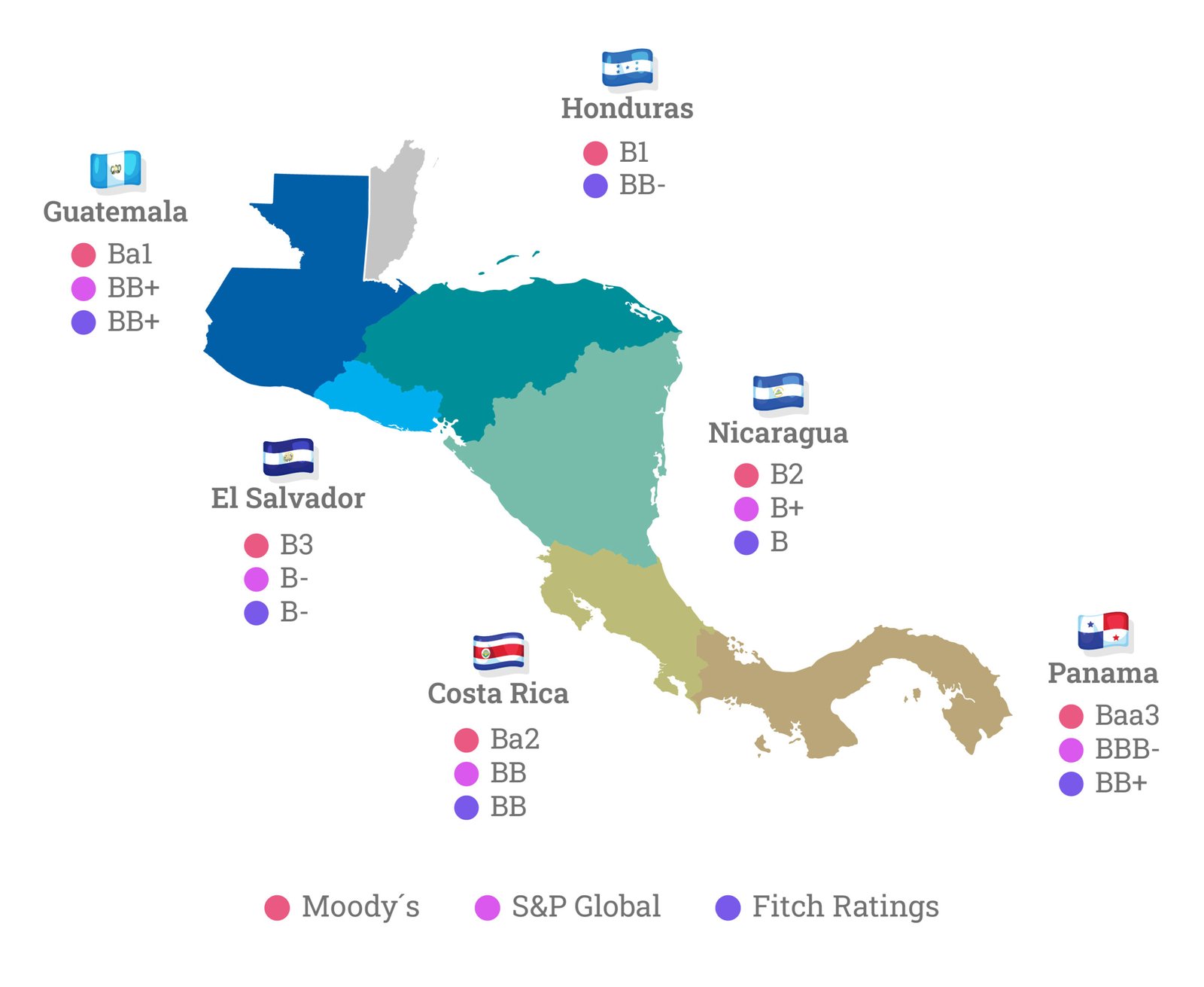
Despite the challenges facing Guatemala, the reality is that the country is the second-highest rated in the region, surpassed only by Panama, which currently holds investment-grade ratings from Moody’s and S&P.
El Salvador faces the bleakest outlook and ranks four places below Guatemala. Even countries that have faced more turbulent political situations in recent years, such as Nicaragua and Honduras, are viewed more favorably by international credit rating agencies.
From Speculative Grade to Investment Grade
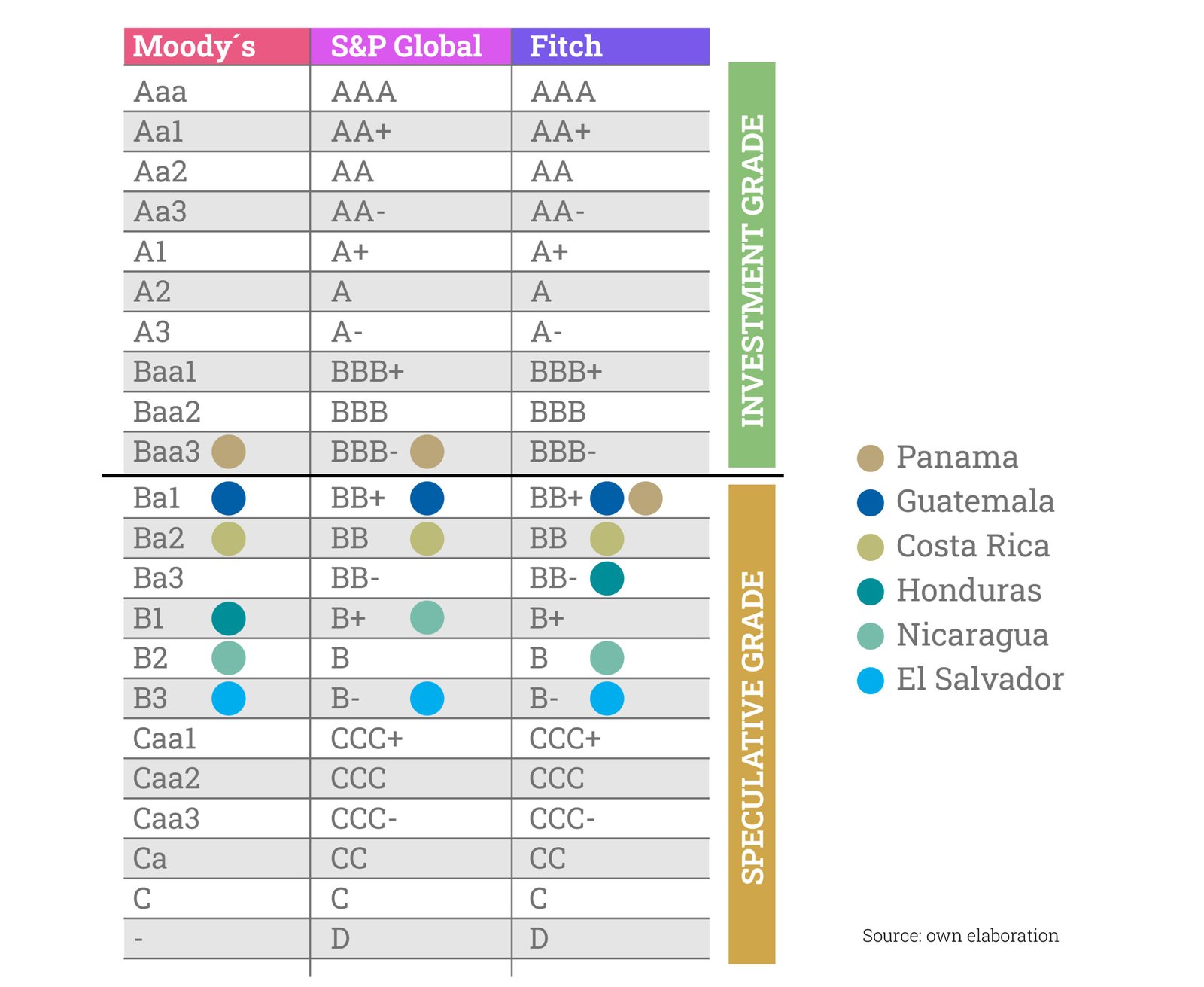
Broadly speaking, the three rating agencies use a scale ranging from triple A to D. These are divided into two main categories, with the top 10 tiers classified as Investment Grade and, below that, Speculative Grade.
The first group includes countries with a low risk of defaulting on their debts and, therefore, a strong position to meet their financial obligations. In the other group, the closer a country gets to D, the greater the risk of default becomes.
Historically, all Central American countries have experienced episodes of default or debt non-payment in the past, especially during the 1980s. Currently, the country that appears to have the highest risk of default is El Salvador, due to a debt-to-Gross Domestic Product (GDP) ratio exceeding 80% and some uncertainty regarding the use of Bitcoin in its economy*[1].
From a macroeconomic perspective, one could argue that Guatemala is in a favorable position to achieve investment-grade status, but it remains to be seen how international agencies will assess the country’s efforts regarding variables related to infrastructure improvements, the fight against corruption, and the strengthening of the Rule of Law.
[1] In February 2025, they signed a $1.4 billion agreement with the IMF in which they committed to limiting the use of Bitcoin and removing its mandatory status. Despite this, President Nayim Bukele has continued to accumulate reserves in that cryptocurrency.
Published on March 23, 2026.