
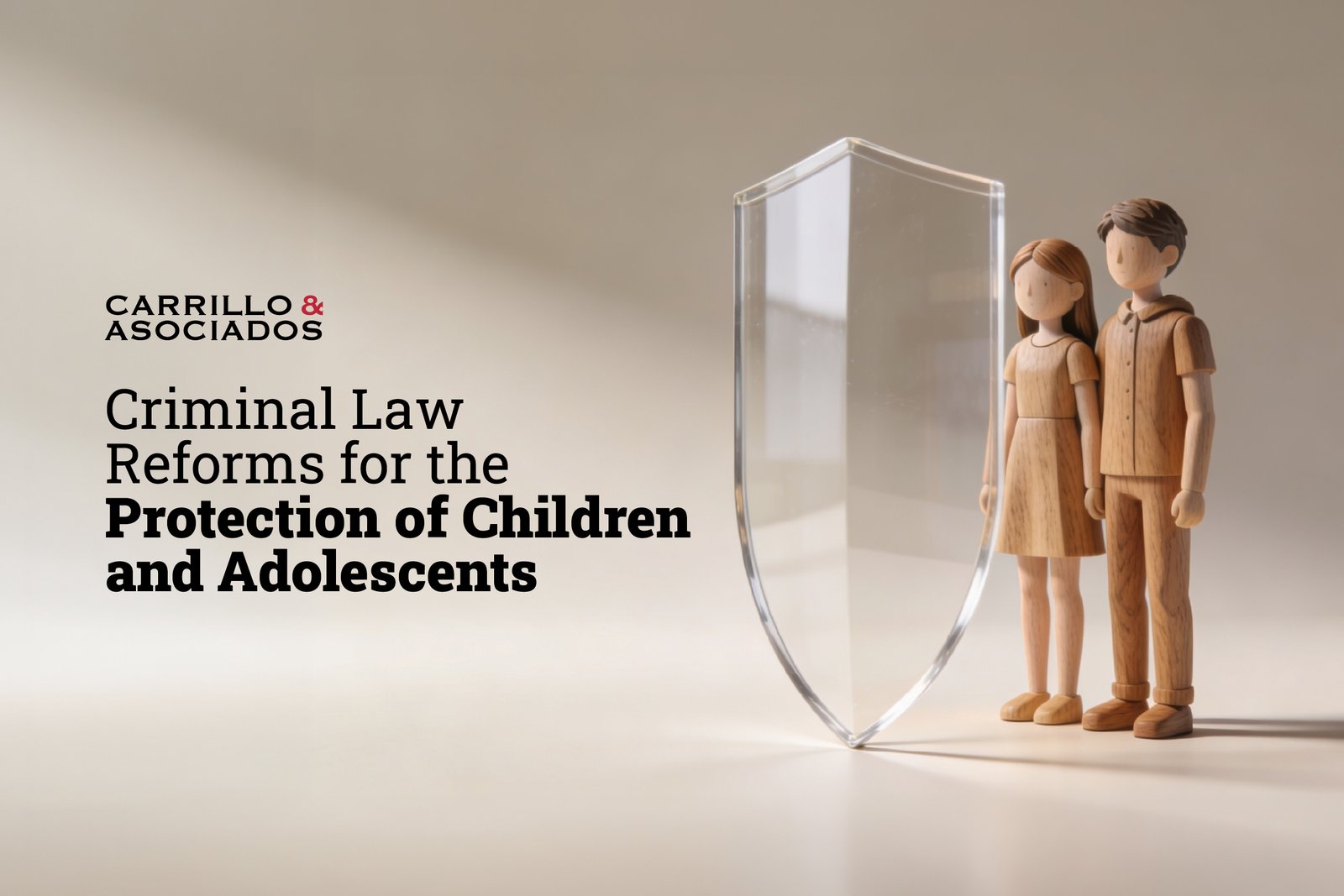
On April 14, 2026, the Guatemalan Congress approved Decree 10-2026 and enacted the Law to Prevent Child Sexual Abuse. This action was taken in compliance with the State’s obligations regarding the protection of the best interests of children (Articles 4 and 5 of the Comprehensive Protection of Children and Adolescents Act) and seeks to protect minors from unequal power dynamics and any form of violence that threatens their integrity and may affect their sexual and psychological development.
The amendments introduced to Articles 173 and 173 Bis of the Penal Code (Decree 17-73) establish that any adult who engages in sexual relations or performs acts for sexual or erotic purposes with a person under the age of 18 commits the crime of rape, even if consent is given, and without the need to prove the existence of physical or psychological violence.
The reform will increase the penalties for the crime of rape. A prison sentence of 8 to 14 years will be imposed in cases involving adults (prior to the reform, the maximum sentence was 12 years). When the victim is a minor, the prison sentence will be 10 to 14 years, with no possibility of commutation.
Penalties for the crime of sexual assault will also be increased. For adults, a prison sentence of 5 to 10 years (prior to the reform, the maximum sentence was 8 years). When the victim is a minor, the prison sentence will be 7 to 10 years, non-commutable.
In cases where the perpetrator is a teenager and the victim is older than fourteen, a socio-educational sanction or orders for guidance and supervision will be imposed—for both the crime of rape and that of sexual assault. These are regulated in Article 238 of the Comprehensive Protection of Children and Adolescents Act.
Additionally, Article 8 BIS regarding the special protection of children and adolescents in the Law Against Sexual Violence, Exploitation, and Human Trafficking was amended. The State is now obligated to guarantee access to all prevention, emergency, treatment, and care services appropriate for their age.
The government must ensure that they receive culturally appropriate legal assistance in their native language, adapted for individuals with speech and hearing impairments; it must also guarantee their access to educational and health programs aimed at preventing early marriages and at detecting and providing care for pregnancies among girls and adolescents. Priority will be given to ensuring that special protection services for children and adolescents are provided locally and on an outpatient basis.
In Guatemala, there is an alarming crisis regarding child and adolescent pregnancies. According to the Reproductive Health Observatory, in 2025 alone, 56,889 births were recorded among girls and women aged 10 to 19[1]. These are typically the result of unequal relationships, where the person responsible for the pregnancy is an adult.
During the first quarter of 2026, the Observatory recorded 531 births to mothers aged 10 to 14 and 15,087 births to mothers aged 15 to 19. The departments with the highest figures are Guatemala, Alta Verapaz, Huehuetenango, San Marcos, and Quiché [2] .
The approved reforms represent a significant change in the protection of the best interests of children and adolescents in Guatemala by incorporating institutional measures for prevention, care, and comprehensive protection.

Published on April 27, 2026
*On Wednesday, May 6, 2026, the Executive Branch vetoed the amendments to the Penal Code approved by Congress on the grounds that they might be unconstitutional. Consequently, the previously approved changes will not take effect.
[1] Reproductive Health Observatory, “Birth Records for Mothers Aged 10–19 – Year 2025,” Osar Guatemala https://osarguatemala.org/registros-de-nacimientos-de-madres-entre-10-19-anos-ano-2025/
[2] Reproductive Health Observatory, “Birth Records for Mothers Aged 10–19 – Year 2026,” Osar Guatemala https://osarguatemala.org/registros-de-nacimientos-de-madres-entre-10-19-anos-ano-2026/