
2026 will be marked by several election processes that could change the course of the institutions responsible for ensuring justice and democracy in Guatemala. In the first half of the year, new magistrates will be elected to the Supreme Electoral Tribunal (TSE), the Constitutional Court (CC), and the Attorney General of the Republic, who will head the Public Prosecutor's Office (MP).
Here is the most important information you need to know about these processes:
Public Prosecutor's Office (MP)
The institution is currently led by Consuelo Porras, who was elected Attorney General in 2018 by President Jimmy Morales and re-elected in 2022 by President Alejandro Giamattei. Her tenure has been marked by international sanctions against her and other close associates, as well as tensions with the current government, which will appoint her replacement.
Since 1994, the Public Prosecutor's Office, an autonomous entity independent of the other branches of government, has been responsible for prosecuting criminal cases in the country, or in other words, investigating, gathering evidence, and bringing cases before the justice system. The Attorney General's Office is the result of the 1993 constitutional reform, when the adversarial criminal justice system currently in force in the country was established. It also has constitutional status, as its functions are regulated by Article 251 of the Constitution.
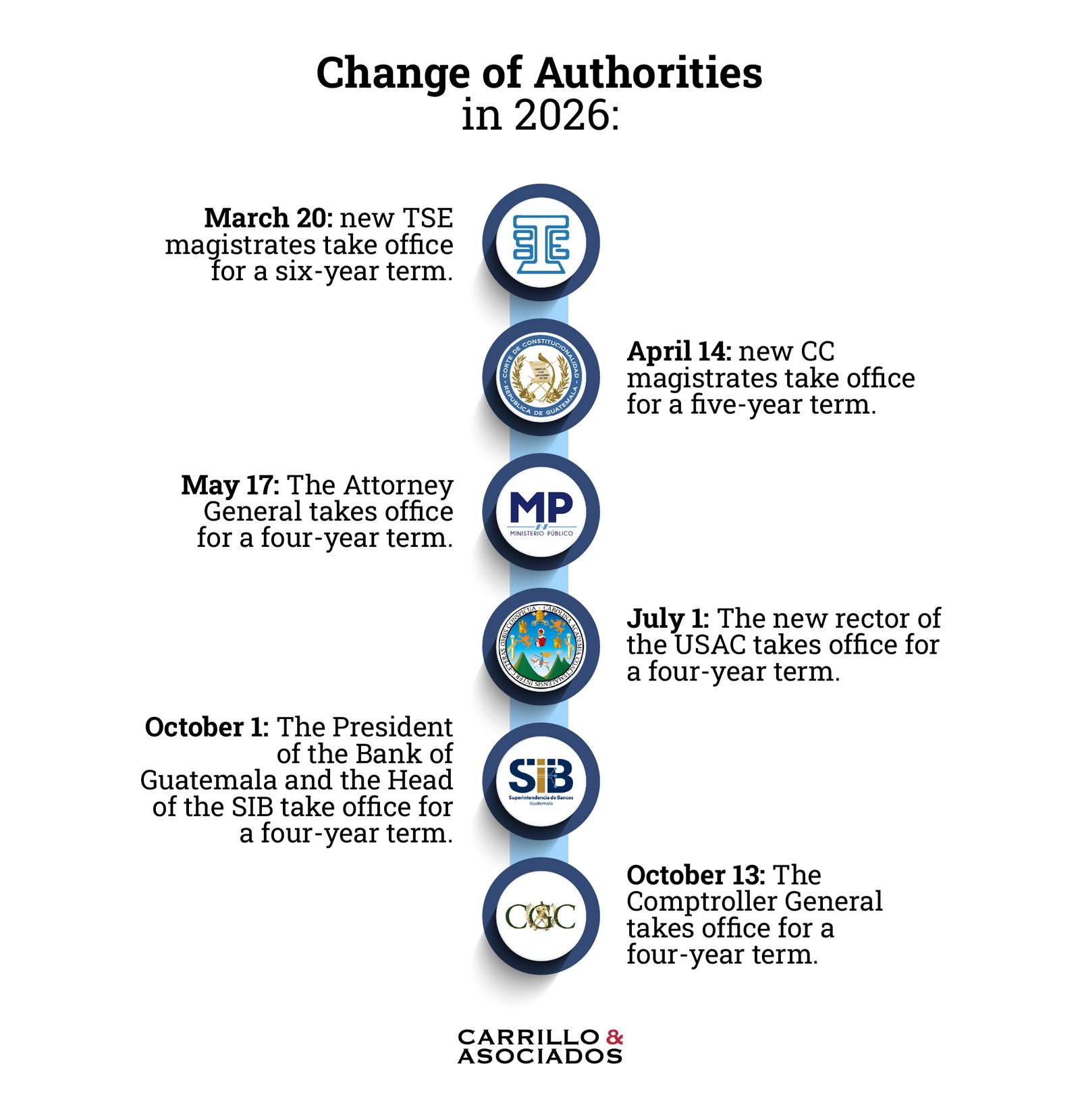
The election process began on January 13 when Congress issued a call for members of the Nomination Commission, which has since been sworn in. Now they must define the ethical, academic, and professional requirements for candidates and evaluate their profiles. Finally, they will submit a list of six candidates to President Bernardo Arévalo, who will be responsible for appointing the new Attorney General before May 1. The new Attorney General will take office on May 17th.
Constitutional Court (CC)
The country's highest court will renew its 10 magistrates in 2026. The CC[1] is fundamental to the country's legal system because it is an independent entity responsible for defending and ensuring constitutional order, guaranteeing that all laws and actions of the State and its officials respect the Constitution.
Five institutions are responsible for electing one presiding magistrate and an alternate for the next five years. The 10 new judges must take office for the 2026-2031 term on April 14, 2026. The following are responsible for electing the magistrates:
- The President with his Cabinet: traditionally, the President directly appoints his two representatives. This year, President Arévalo issued a call for anyone who meets the requirements to apply.
- The Guatemalan Congress: Congress issued an open call for applications. After an initial screening of candidates by the bloc leaders and the Board of Directors, the plenary session will vote to elect its representatives, who must receive at least 81 votes. If several candidates achieve this level of support, those with the most votes will be appointed.
- The Supreme Court of Justice: In the absence of regulations governing the process, the Judiciary could open a process to receive applications or bring their own candidates in private to be elected by the court by majority vote. They have not yet announced how the election will be conducted.
- The Guatemalan Bar Association (CANG): CANG members have already voted to elect their two representatives to the CC. The election was marked by controversy, as a court ruling, backed by the current Constitutional Court, prevented professionals from related fields, such as political scientists, sociologists, internationalists, and criminologists, who are members of the Association, from voting. Additionally, on election day, the Public Prosecutor's Office attempted to interfere with the process by arriving at three of the polling stations to conduct raids with heavily armed personnel. Despite the intimidation, the democratic process prevailed and the elected magistrates are: Astrid Lemus (sitting judge) and Luis Fernando Bermejo (alternate).
- Higher University Council (CSU) of the University of San Carlos de Guatemala (USAC): after convening the process and receiving applications, the representatives of the public university must choose the candidates. It is important to note that national and international organizations have pointed out that the CSU cannot elect its magistrates because many of its representatives' terms have expired. These changes have even been ordered by the current Constitutional Court, but to date, the order has not been complied with.
Supreme Electoral Tribunal (TSE)
This Court is the highest authority on electoral matters and will be responsible for conducting the general elections of 2027 and 2031. Its authorities have the power to resolve disputes over registrations, sanctions, suspensions, or cancellations of candidates and political parties. Therefore, the new magistrates will play an important role in the upcoming electoral process.
It is important to remember that the TSE "is independent and, therefore, not subject to any State body"[2]. Furthermore, the Electoral and Political Parties Law is constitutional in nature. Even the CC doctrine has included it as part of the constitutionality block.
Congress is responsible for electing the five magistrates and their five alternates of the Supreme Electoral Tribunal for the 2026-2032 term. They will be selected from a list of 20 candidates drawn Nomination Commission. The new officials are to take office on March 20, 2026.
Other elections
In 2026, the Comptroller General of Accounts, the Rector of the University of San Carlos de Guatemala, the Superintendent of Banks, and the President of the Bank of Guatemala and the Monetary Board will also be elected. In addition, at the international level, the United States will hold its midterm elections in November, which could have an impact on the region.
Given this scenario, it is important to keep an eye on these processes, which will be fundamental for the future of justice and democracy in the country.
[1] According to Article 268 of the Political Constitution of the Republic, the Constitutional Court: ""Is a permanent court with exclusive jurisdiction, whose essential function is to defend the constitutional order;"
[2] Article 121 of the Electoral and Political Parties Law emphasizes that the TSE "is independent and, therefore, not subject to any State body." Furthermore, this provision is contained in Decree 1-85 of the Constituent General Assembly, which was responsible for drafting the current Constitution, giving it constitutional status.
Published on February 16, 2026.